
Mechanical planning for the Merrimack Valley
Modern comfort through old brick and tight routes.
Lowell pairs mill-era brick buildings and dense worker housing with triple-deckers, later suburban streets, and adaptive-reuse lofts. HVAC planning must reconcile masonry, tall stacks, compact chases, old hydronics, electrical limits, heat-pump performance, humidity, and noise.
Independent matching resource · No-pressure requestWhole-building comfort
Equipment is one part of the system.
Downtown mill conversions, Belvidere, the Highlands, Centralville, and Pawtucketville each bring different envelopes and distribution paths. High ceilings, brick walls, multifamily layouts, finished attics, and additions reward measured design rather than equipment swaps.
Read the planning guide →Heating and cooling
Organized around comfort and performance.
Heating Repair
Diagnose no-heat, uneven rooms, noise, short cycling, ignition, pumps, controls, and distribution before choosing parts.
Explore →02Air Conditioning
Plan cooling around heat gain, humidity, airflow, electrical capacity, condensate, and realistic equipment placement.
Explore →03Heat Pumps
Cold-climate heat pumps can heat and cool, but sizing, distribution, controls, backup strategy, and envelope all matter.
Explore →04Boilers & Furnaces
Replacement planning should connect fuel, venting, water or air distribution, controls, safety, and actual building load.
Explore →05Indoor Air Quality
Filtration, ventilation, humidity, source control, duct leakage, and maintenance work together—not as isolated gadgets.
Explore →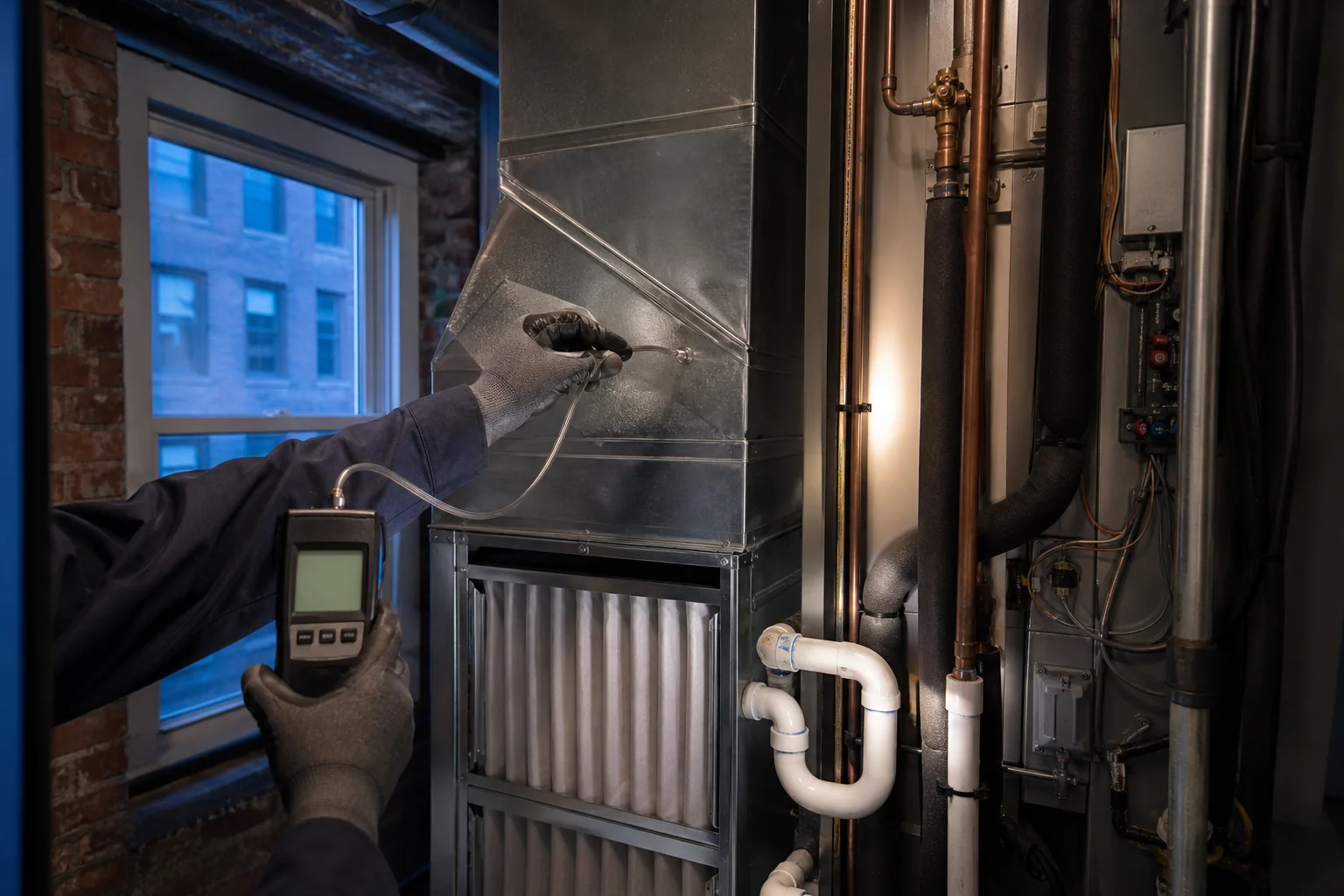
The invisible work
Sizing, distribution, drainage, controls, and commissioning matter.
A polished machine cannot overcome poor airflow, unbalanced hydronics, bad control logic, blocked returns, weak drainage, or a building load nobody measured.
See a sensible processBuildings change
Downtown mill conversions, Belvidere, the Highlands, Centralville, and Pawtucketville each bring different envelopes and distribution paths. High ceilings, brick walls, multifamily layouts, finished attics, and additions reward measured design rather than equipment swaps.
Planning-level context
Price follows capacity, distribution, access, and scope.
Equipment, electrical work, venting, duct or piping changes, refrigerant routes, condensate, controls, permits, and envelope needs all shape a quote.
Open the cost guide →A calmer first step
Describe the comfort problem.
For fuel odor, carbon-monoxide alarms, smoke, fire, sparking, or unsafe conditions, leave the area and contact emergency services or the utility as appropriate.
Questions before the estimate
Are you the HVAC contractor?
No. This is an independent lead-generation and contractor-matching resource.
Does old equipment always need replacement?
No. Safety, condition, repairability, efficiency, comfort, distribution, and future plans all matter.
Can equipment size match the old nameplate?
Not reliably. Building changes and original sizing errors make load assessment more useful.